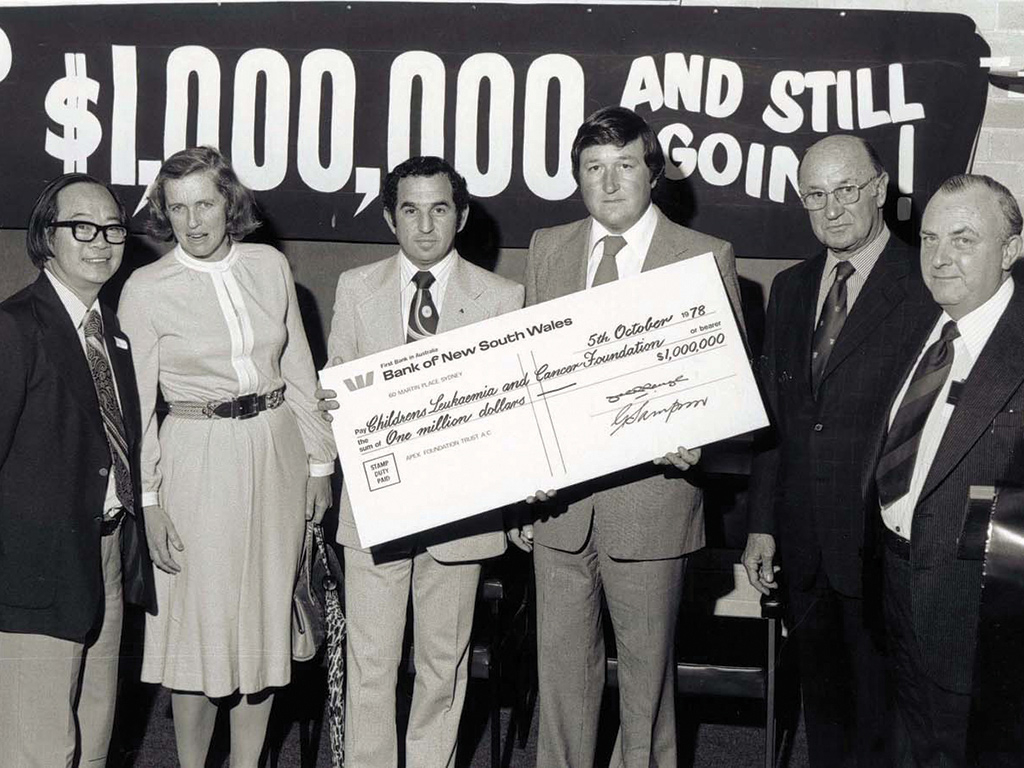
Finally, the day came when the Foundation opened its research unit: The Apex Centre. At the opening ceremony, those present were moved to tears when Dr O’Gorman Hughes asked all survivors of childhood cancer to stand up. A silence fell over the crowd as, one by one, these children and adults stood up − a dramatic demonstration of the importance of the Centre’s work

The day we opened the centre was the day I realised we were on track … that we could finally begin to do something about curing this terrible illness.
– Jack Kasses, Institute founder
Professor O’Gorman Hughes took the helm as Honorary Medical Director and Dr Bernard Stewart was appointed to head research operations, with Don Reece the Chairman officiating. In 1984, the first three scientists were employed to work in the new laboratories. Remarkably, those same scientists − Professors Michelle Haber, Maria Kavallaris and Murray Norris − remain at the Institute to this day. Also integral to the first research team were Dr Les White (who went on to become head of Sydney Children’s Hospital from 1995-2010, and is a current Institute Board member) and Dr Marcus Vowels, both appointed as Clinical Associates.
There was an understanding that parents and doctors were putting their trust in us. There was a sense of responsibility from the very first day.
– Prof Michelle Haber AM, Executive Director
Within 12 months, the Centre had attracted its first research grants, and within two years, it employed a dozen staff. By 1988, space was starting to run out. Plans were made to add three stories on top of the existing laboratories, and following a grant of $1.2 million from the NSW Government, the expanded ‘Children’s Leukaemia and Cancer Research Centre’ opened in April 1992. Three years later, the organisation changed its name to Children’s Cancer Institute Australia.
In 1996, dizzy new heights were reached when the Institute published in the world’s top medical journal, The New England Journal of Medicine, sharing its research findings that treatment failure in children with neuroblastoma was linked with high levels of the multidrug resistance-associated protein (MRP) gene. A few years later, a major stride was made in leukaemia research when the Institute’s scientists developed a molecular test able to detect ‘minimal residual disease’ (MRD) − the burden of remaining cancer cells surviving treatment − in children with acute lymphoblastic leukaemia (ALL), allowing the early prediction of relapse and changing the landscape of treating ALL.
Key to the progress being made in translational research – research aimed at solving real-life clinical problems – was the close connection between the Institute’s scientists and the oncologists at Sydney Children’s Hospital. Dr Glenn Marshall, head of the Kids Cancer Centre at the Hospital from 1998 to 2016 (and now Head of Translational Research at the Institute), was instrumental in fostering this relationship and remains a driving force in getting clinicians involved in research.
Our success in those early days, and in fact since, stemmed from working closely with the doctors at Sydney Children’s Hospital to understand the most pressing problems facing children with cancer and then, as scientists, endeavouring to provide a solution.
– Prof Murray Norris AM, Deputy Director
In 2000, the Institute’s inaugural scientists, Michelle Haber and Murray Norris, were appointed Executive Director and Deputy Director, respectively. The Institute also qualified for NSW Government Research and Development Infrastructure funding – a significant boost to its ability to finance ongoing operations. Once again, it became clear that more space was needed for ever-growing staff numbers, and the ‘10 out of 10’ appeal was launched to raise the millions of dollars required.
2002 saw two major developments in the Institute’s leukaemia research, with its minimal residual disease (MRD) test entering a decade-long national clinical trial, and its unique laboratory model of ALL (closely resembling ALL in humans) published in the world’s leading haematology journal, Blood. The latter proved instrumental in the Institute being chosen in 2004 as the leukaemia testing site of the Pediatric Preclinical Testing Consortium, a US-led initiative to prioritise the most promising childhood cancer drugs for clinical evaluation.
At the same time, the Institute’s scientists were making major headway in neuroblastoma research. A vital clue to the origins of the disease came with the finding that, in mice with extra copies of an oncogene known as MYCN, neuroblastoma develops from embryonic cells that abnormally persist beyond birth. The following year, the Institute filed an international patent on compounds capable of reversing drug resistance in neuroblastoma, developed in collaboration with the Cleveland Clinic, USA.
The Institute’s contribution to Australian drug discovery received a major boost with the launch of its newest facility, the Australian Cancer Research Foundation (ACRF) Drug Discovery Centre for Childhood Cancer, which coincided with the move to the Lowy Centre. With robotic instrumentation allowing the rapid screening of thousands of ‘small molecule’ compounds to identify those with anticancer properties, the Centre would prove pivotal to the Institute’s drug discovery capability.
This capability was put to good use when the Institute began an Australian-first research project into a uniformly fatal childhood brain cancer known as diffuse intrinsic pontine glioma (DIPG) in 2012. An intensive effort to find effective treatments for children diagnosed with this disease led to the discovery of several promising compounds, and the first of a series of clinical trials to test these drugs opened in 2018.
We were pioneers - we didn’t know where we were going, but I don’t think any of us in any of our dreams realised how good it was going to be.
– Margaret Lough, Institute founder