Our story began in 1975, when the parents of two children with leukaemia, 6-year-old Helen Kasses and 2-year-old Robbie Lough, met in the waiting room at Sydney Children’s Hospital (then the Prince of Wales Children’s Hospital)
Like most other parents in their situation, Jack & Annette Kasses and John & Margaret Lough knew next to nothing about childhood cancer. They soon learned the devastating statistics: hundreds of Australian children were being diagnosed every year, and only about half survived.
At the time, the only place where children could receive treatment for cancer was in an old demountable (converted military hut) at the back of the Prince of Wales Hospital. And while it was clear that the doctors were doing all they could to cure the children in their care, it seemed that very little was being done in the way of research into childhood cancer, anywhere in the country.

In those days, it was a very dark and unknown world. Very little was known about childhood cancer. Most children died.
– Jack Kasses, Institute founder
Making matters worse for many families was that there was no accommodation or financial assistance for those who needed to travel from country areas of NSW, or interstate, to the treatment centre in Sydney. Tragically, some parents felt they had no choice but to take their child home to die. Jack Kasses, and social worker at the hospital, Margaret French, vowed to do something about this dire situation.
It was a very different world back then. There was no Ronald McDonald House - there was nowhere families could stay.
– Margaret French, Hospital Social Worker
The parents of children with cancer were doing all they could to support what little research was being undertaken. Les & Jean Parry, who had lost their little boy Kenny to cancer, were running regular fundraising events; George & Tina Georgiou had established a fund in memory of their daughter Helen. But more needed to be done.
I asked Dr O’Gorman Hughes: what would be the best way to help? He said if every person in Australia donated $1, we’d be able to save a lot of children.
– Tina Georgiou, Institute founder.
Working all-hours at the hospital, Drs Darcy O’Gorman-Hughes and Marcus Vowels were acutely aware of the problem. Through discussions among this dedicated group of parents and doctors, an idea began to take shape. If all concerned parties were to join forces, perhaps they could make a real impact.
On 18 May 1976, a meeting was held at the Kasses’ home to discuss how the group might go about setting up a foundation to fund the construction of a research centre, as well as provide a social welfare program for families in need. The Children’s Leukaemia and Cancer Foundation was established, and planning began to raise the required funds.
See our Founders Honours Board
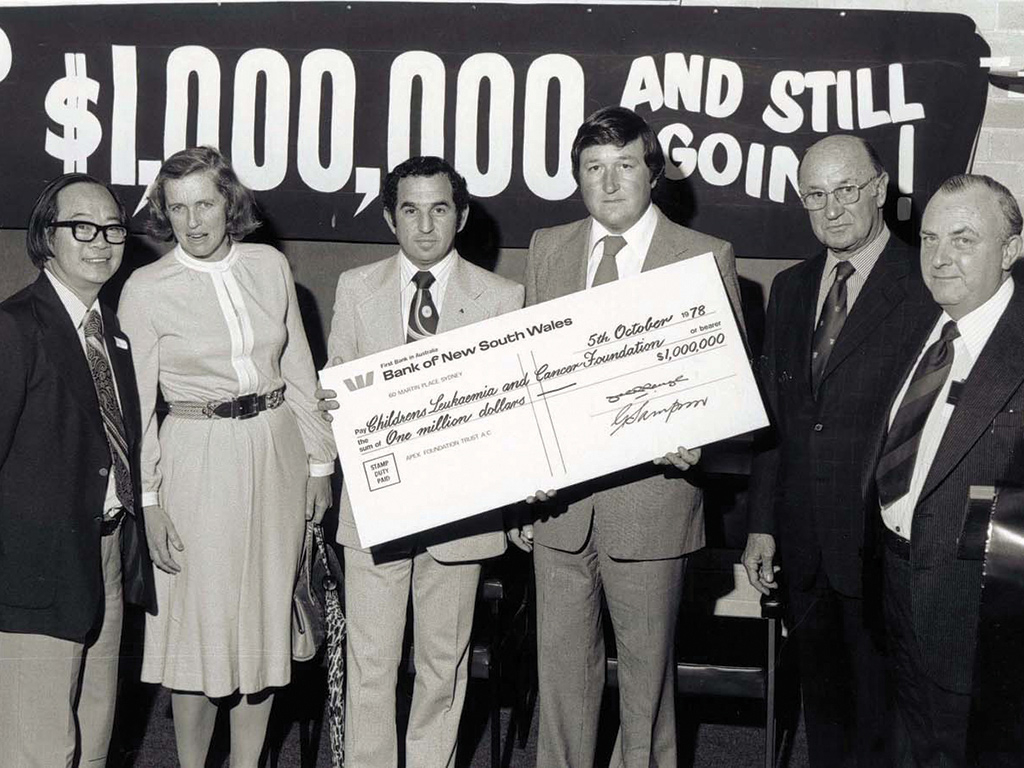
In July, John Lough approached his local Apex Club in Wollongong to ask if they would support him in putting forward the new Foundation as the 1977/78 Apex national service scheme. They agreed, and after months of intense lobbying, the proposal was accepted. Apex enlisted the help of renowned advertising guru John Singleton, who designed marketing material for the campaign ‘Some kids make it, some kids don’t − Help a kid make it’. In just one year, a staggering $1.3 million (the equivalent of about $8 million today) was raised. Plans for construction of the Foundation’s research unit could now begin in earnest.
We worked out that with 860-odd Apex Clubs, if each club raised $1,345.67 we would have $1 million.
– Tina Georgiou, Institute founder.